- Home
- >
- Wireless
- >
- Kaelus iPA Series PIM Tester
Kaelus iPA Series PIM Tester
Battery Portable Passive Intermodulation Analyzer
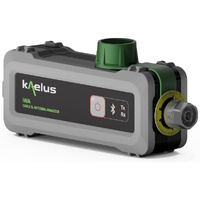
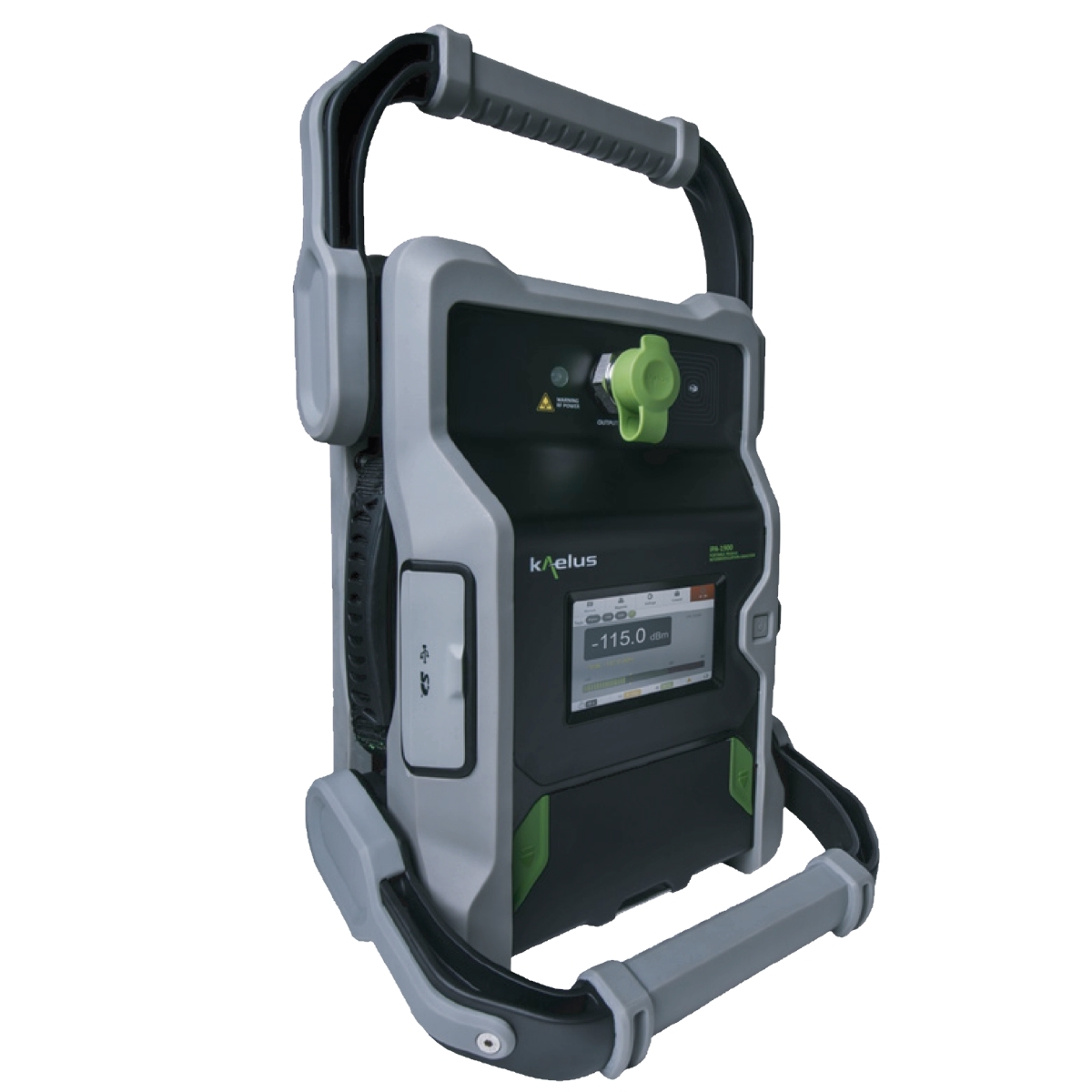
The Kaelus iPA Series PIM tester is a battery-powered passive intermodulation (PIM) analyser for cell sites and in-building DAS. It transmits two high-power carriers and measures the reflected intermodulation product that lands in the receive band. You run it from a 4.3 inch touchscreen or from any Wi-Fi device with a web browser. An optional range to fault module then locates the source of the PIM. TMG is an authorised Kaelus distributor and supplies the iPA Series for purchase and rent in Australia.
Why PIM testing matters at a cell site
PIM occurs when two or more strong signals mix in a passive component that behaves non-linearly. A loose, corroded or contaminated connector is a typical example. When the mixing products fall in the receive band, they raise the receive noise floor. As a result, uplink sensitivity drops, and coverage and data throughput suffer with it.
PIM faults can degrade uplink sensitivity without appearing on a return loss sweep. A site can therefore pass a return loss sweep and still fail on PIM. Cell site commissioning includes PIM alongside return loss and distance to fault measurements. Test at installation and again whenever equipment is added to a site or components age.
Pass criteria are typically set by the carrier’s specification, so confirm the limit before you test. However, the measurement method is a separate matter. IEC 62037-2:2021 defines a procedure for measuring PIM generated by a coaxial cable assembly, such as a jumper cable. For a plain-language primer, read what PIM testing involves.
Where the Kaelus iPA Series PIM tester is used
Kaelus specifies the iPA Series for four test positions: top of tower, base of tower, rooftop and in-building DAS. The hardware is built for field access. It weighs 12 kg and has a 40G shock rating. In addition, it carries an IP54 rating (IP67 when enclosed in the optional hard case) and operates from -10 °C to +45 °C.
The unit runs from battery, so no mains supply is needed at the test point. Each removable pack gives a minimum of 3 hours, depending on use. Remote control from a phone, tablet or laptop also lets the technician flex cables and tap connectors while watching the live reading. This is dynamic testing.
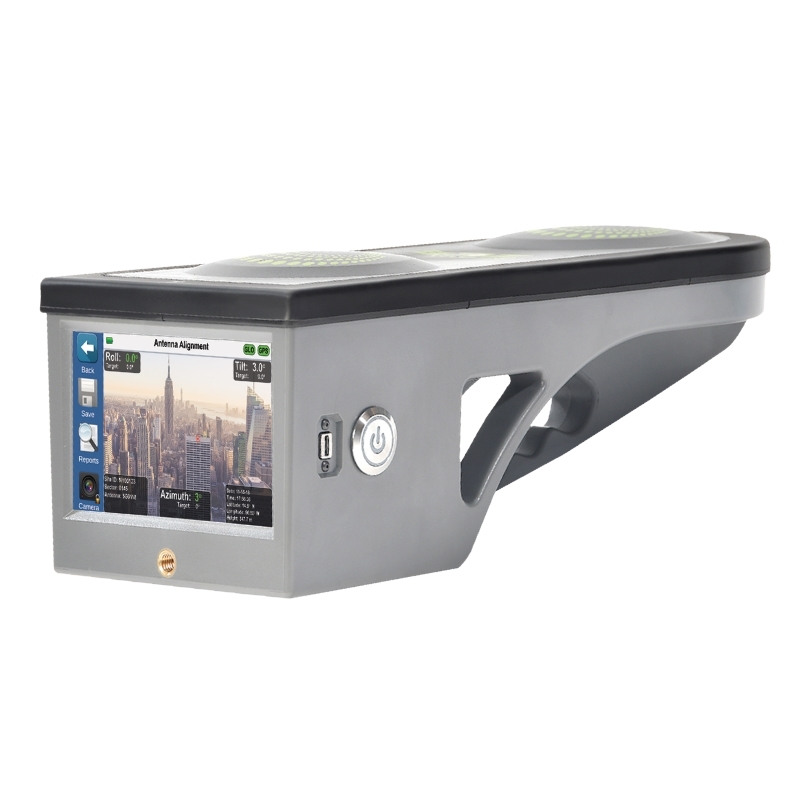
For the wider range of RF, antenna alignment and EMF instruments TMG supplies, see wireless test equipment.


How the iPA Series measures PIM
The iPA Series measures reverse (reflected) PIM. It reports third, fifth and seventh order products on the iPA-0707D and iPA-0850A. The other models report up to ninth order. Transmit power per tone is adjustable in 1 dB steps. A series models cover 0.1 to 20 W (+20 to +43 dBm). The D series extends to 40 W.
Three measurement modes are available:
- PIM over frequency: a frequency sweep that moves the intermodulation product across the receive band.
- PIM over time: a time trace of the PIM level.
- Spectrum monitor: a view of the receive band.
The instrument itself generates a small amount of PIM. Therefore the residual figure sets the floor of what you can measure. Kaelus specifies residual PIM below -117 dBm (-160 dBc) maximum and below -125 dBm (-168 dBc) typical at two 20 W carriers. The receiver measures from -50 dBm to -128 dBm with a noise floor below -128 dBm.
A return loss alarm protects the instrument. If it detects high return loss, it shuts the transmitters down automatically.
Kaelus iPA Series PIM tester specifications
| Parameter | Specification |
|---|---|
| Measurement method | Reverse (reflected) PIM. 3rd, 5th and 7th order (iPA-0707D, iPA-0850A); 3rd, 5th, 7th and 9th order (other models) |
| Residual PIM | < -117 dBm / -160 dBc max; < -125 dBm / -168 dBc typical, at 2 x 20 W |
| Power per tone | A series: 0.1 to 20 W (+20 to +43 dBm). iPA-0600D: 100 mW to 40 W (+20 to +46 dBm). iPA-0707D: 1 to 40 W (+30 to +46 dBm). 1 dB steps |
| Power accuracy | ±0.5 dB maximum per tone |
| Frequency increment and accuracy | 100 kHz steps; ±5 ppm maximum, ageing ±1 ppm maximum after the first year |
| Receiver | -50 dBm to -128 dBm; noise floor < -128 dBm |
| Interface ports | RF output (7-16 DIN female), USB 2.0 host, USB 2.0 slave, SD, monitor port (SMB female), SMA-RP for an external Wi-Fi antenna |
| User interface | Local 4.3 in (109 mm) touchscreen. Remote from a tablet, computer or any Wi-Fi device with a web browser |
| Battery | Removable lithium-ion packs, 25.2 VDC, 3.45 Ah, 87 Wh. 3 hours minimum per pack, depending on use |
| Size and weight | 369 x 160 x 240 mm (H x D x W); 12 kg |
| Environment | -10 °C to +45 °C operating; -10 °C to +60 °C storage; 5% to 95% RH non-condensing; IP54 (IP67 in optional hard case); 40G shock |
Source: Kaelus iPA Series datasheet, Rev 29. Specifications are subject to change without notice.
Range to fault module
The optional Range to Fault (RTF) module measures distance to PIM faults and distance to return loss faults. As a result, the location of a PIM source can be read from the instrument. The RTF module is sold separately. Each iPA model pairs with RTF-1000, RTF-2000 or RTF-2600, as the table below shows.
Kaelus iPA Series PIM tester configurations
The iPA Series is built per frequency band. Kaelus lists the following configurations. Ranges are in MHz.
| Model | Band | TX1 | TX2 | RX (PIM) | RTF module |
|---|---|---|---|---|---|
| iPA-0600D | 600 MHz | 617-630 | 640-652 | 663-698 | RTF-1000 |
| iPA-0707D | 700 MHz low/high | 728-731.5 | 741-764 | 698-716; 776-802 | RTF-1000 |
| iPA-0703A | APT700 LTE | 758-768 | 778-803 | 703-748 | RTF-1000 |
| iPA-0790A | LTE 800 | 791-796 | 808-821 | 832-862 | RTF-1000 |
| iPA-0850A | 850 MHz | 869 | 879-894 | 824-849 | RTF-1000 |
| iPA-0901A | EGSM900 | 925-935 | 945-960 | 880-915 | RTF-1000 |
| iPA-1800A | DCS1800 | 1805-1812 | 1825-1880 | 1710-1785 | RTF-2000 |
| iPA-1802A | DCS1800 | 1805-1830 | 1840-1880 | 1710-1785 | RTF-2000 |
| iPA-1921A | Dual band PCS/AWS | 1930-1950; 1930-1950 | 1970-1990; 2110-2155 | 1850-1910; 1710-1755 | RTF-2000 |
| iPA-2100A | UMTS (3rd and 7th) | 2110-2130 | 2150-2170 | 1920-1980; 2050-2090 | RTF-2000 |
| iPA-2600A | LTE 2600 | 2620-2630 | 2650-2690 | 2500-2570 | RTF-2600 |
Contact TMG to confirm which configuration suits the bands you test and which are available to buy or rent.
What is in the box
Kaelus lists an AC adaptor and one battery pack as the standard contents. However, a tablet to control the iPA is not included, and neither is a dual battery charger for standalone charging. Accessories include the RTF module, a PIM instrument self-calibration tool and a portable PIM accessory kit.
Rent or buy a Kaelus iPA Series PIM tester
TMG sells the Kaelus iPA Series and also rents it. The TMG rental fleet lists iPA-0703A, iPA-0850A and iPA-1800A kits. The iPA-0850A rental kit lists the analyser, a PIM source and a PIM load. It also lists a test cable, a shifter, a torque wrench, batteries and a dual battery charging cradle, supplied in a transit case.
TMG’s Calibration & Repair Centre is the official repair centre for Kaelus and lists PIM testers under communications and diagnostic calibrations.
Common mistakes before you test
- Testing through an antenna without approval. Kaelus warns that radiating mode may breach licensing regulations, for example when the analyser is connected to an antenna outside an anechoic environment. Obtain permission in advance from any licensed operator the test could affect. Radiating high RF power is also a personnel risk. In Australia, the ACMA states that radiocommunications equipment cannot be used without a licence, so confirm what applies before you transmit.
- Ignoring the environment around the antenna. Sources of PIM beyond the antenna can radiate back into it. A result taken through an antenna therefore reflects the surroundings as well as the antenna itself.
- Skipping the test setup. Leads, adapters and loads are part of the measurement path. The iPA-0703A rental kit, for example, includes a low IM cable and a low PIM load.
This guidance is an example only. It is not a substitute for site-specific procedures, the manufacturer’s operating instructions or a licensed practitioner.
Kaelus iPA Series PIM tester FAQs
What is a PIM tester used for?
A PIM tester measures the intermodulation products that passive RF components generate when carrying high-power signals. These products can fall in the receive band and degrade uplink performance. The iPA Series finds them at cell sites and in DAS, and the optional RTF module locates the source.
Does the iPA Series include a tablet?
No. The Kaelus datasheet states that the tablet used to control the iPA is not included. Instead, you can control the analyser from any Wi-Fi device with a web browser.
Is the range to fault module included?
No. The RTF module is an optional accessory sold separately. However, each iPA model pairs with a specific RTF module, listed in the configurations table.
Can I rent a Kaelus iPA analyser in Australia?
Yes. TMG rents Kaelus PIM analysers, and its rental fleet currently lists iPA-0703A, iPA-0850A and iPA-1800A kits. Contact TMG to check availability for your project dates.